Power Inverters Selection Matrix: How to Choose the Right Inverter for Your Application
Choosing the right power inverter is not simply about picking a higher wattage. The right choice depends on what you need to power, how much power your equipment uses, how much power it needs when starting, and what DC battery system you use.
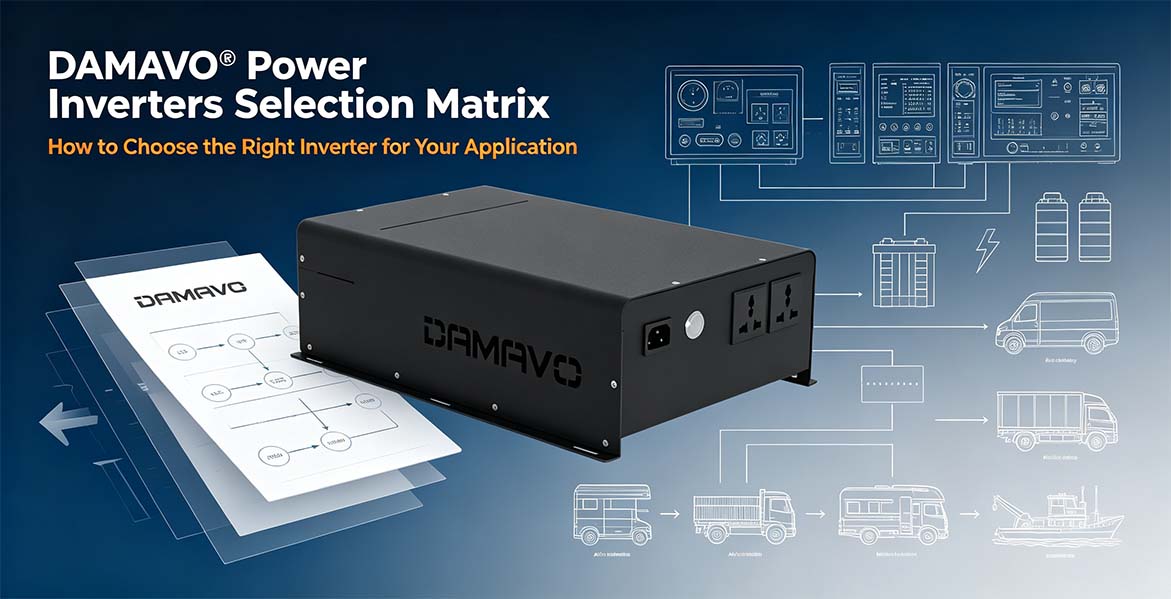
At DAMAVO®, we believe a good inverter selection should start with the application and load, then move step by step to power, voltage, and waveform.
Key Takeaways:
- Match the inverter with your actual load, not just the equipment name.
- Check both continuous power and startup surge power.
- Choose 12V, 24V, or 48V input based on your battery system.
- Select the right waveform for the equipment you need to power.
- Consider the complete application before choosing the final inverter.
DAMAVO® Power Inverter Selection Matrix: Start With Your Application
Different applications need different power inverter configurations. A solution that works well in an RV may not be the best choice for a truck, agricultural machine, or industrial system.
When we develop power solutions at DAMAVO®, we usually start with one simple question: What does the inverter need to power?
From there, we look at the main selection factors:
| Selection Factor | What to Check | Why It Matters |
| Application | RV, truck, machinery, marine, etc. | Defines the working conditions |
| Load | Motor, compressor, electronics, etc. | Affects compatibility |
| Continuous Power | Normal running power | Defines basic inverter capacity |
| Surge Power | Startup power | Important for motors and compressors |
| DC Input | 12V / 24V / 48V | Must match the battery system |
| Waveform | Pure / Modified Sine Wave | Affects load compatibility |
You can also explore the full range of DAMAVO® power inverter solutions to compare different inverter configurations and applications.
Step 1: Determine How Much Power Your Load Needs
Power is one of the first things to check, but it should not be the only thing you check.
Start by listing everything that the inverter will power. This could include lights, refrigerators, computers, chargers, pumps, motors, or other electrical equipment. Then calculate the total power needed during normal operation.
Here is an important point:
Continuous power and surge power are not the same.
A motor or compressor may use a certain amount of power while running but require much more power for a short time when it starts. If you choose an inverter based only on the normal running power, the inverter may overload when the equipment starts.
For this reason, we recommend checking both:
- Continuous Power — the power needed during normal operation.
- Surge Power — the short-term power needed during startup.
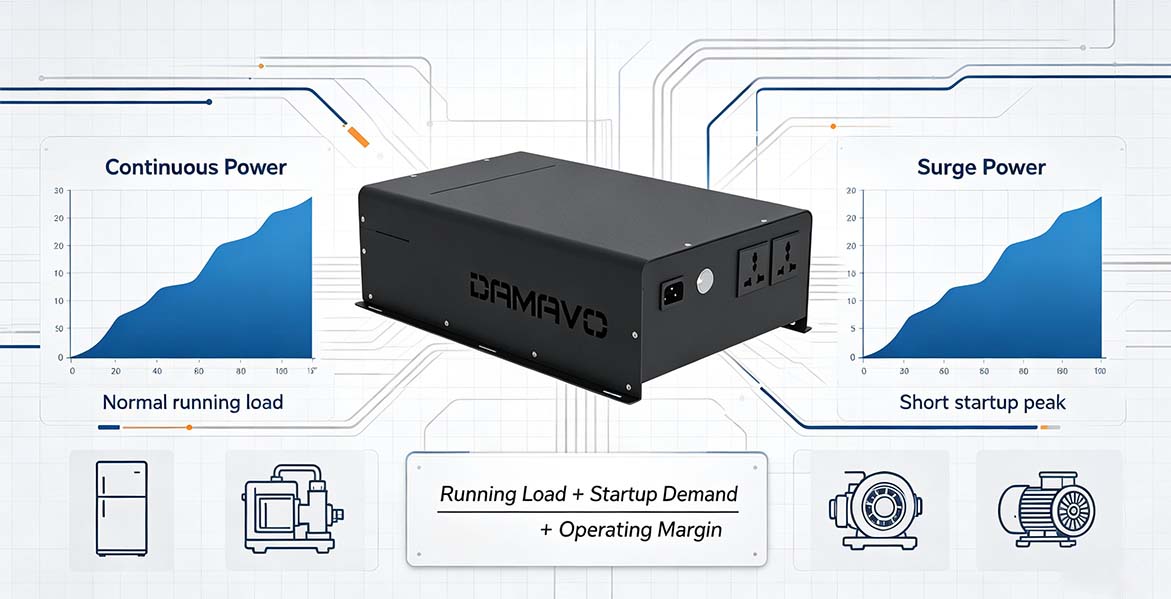
The goal is not simply to choose the biggest inverter. It is to choose one with enough continuous and surge capacity for your actual load.
Step 2: Choose the Right 12V, 24V, or 48V Input
Once you understand the load, check your battery system.
Your power inverter must be compatible with the DC voltage of your battery system. Common options include 12V, 24V, and 48V.
For the same output power, a higher DC voltage generally means lower input current. For example, a 3000W load would require about:
- 12V: 250A
- 24V: 125A
- 48V: 62.5A
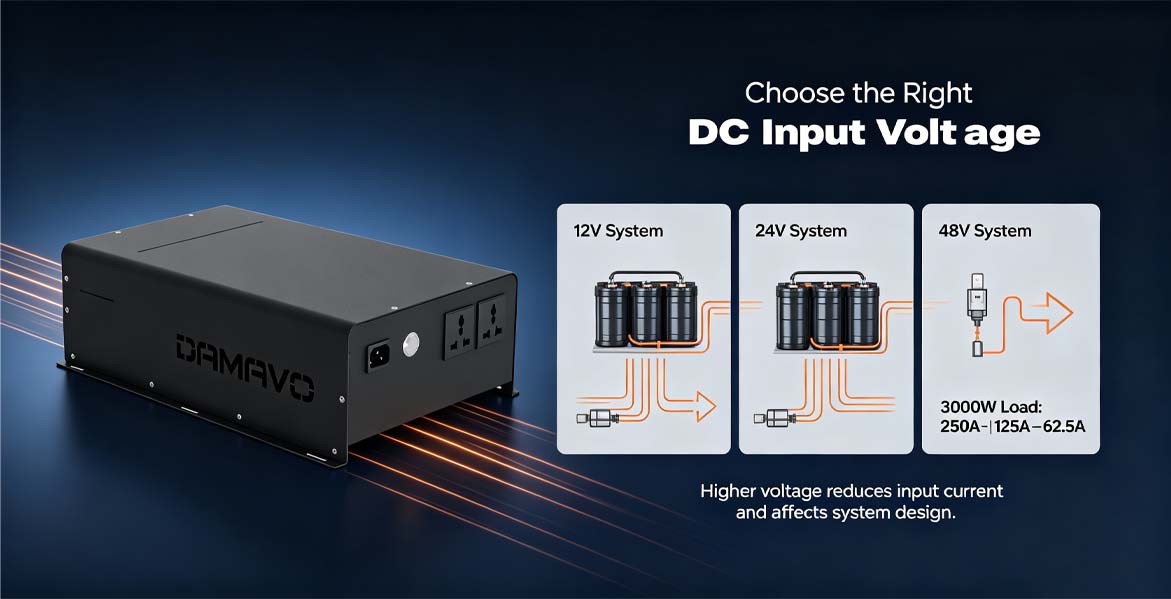
These are theoretical values. Actual current will also depend on inverter efficiency and operating conditions.
This is why a high-power inverter is not only an inverter selection issue. You also need to consider the battery, DC cables, fuses, connections, and the complete power system.
Step 3: Choose the Right Waveform for Your Load
After checking power and voltage, the next question is waveform.
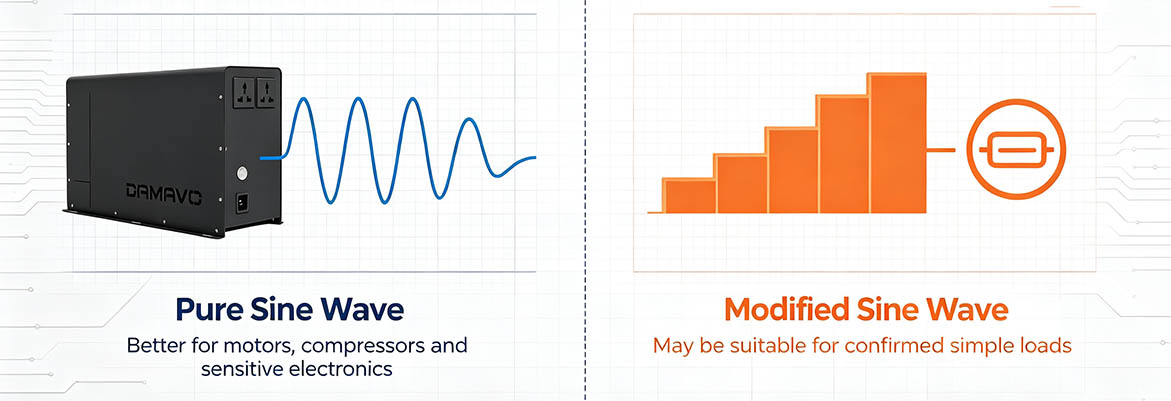
The two common choices are Pure Sine Wave and Modified Sine Wave. The better option depends on the equipment you need to power.
When Should You Choose a Pure Sine Wave Inverter?
If your system includes motors, compressors, control systems, sensitive electronics, or mixed loads, a Pure Sine Wave Inverter is often the safer choice.
Pure sine wave output is closer to the AC power supplied by the utility grid and works well with a wide range of equipment.
You can learn more about this option on our Pure Sine Wave Inverter page.
When Can a Modified Sine Wave Inverter Be Used?
A Modified Sine Wave Inverter may be suitable for simpler loads when compatibility has already been confirmed.
We do not recommend choosing between the two waveforms simply by asking which one is “better.” A better question is:
Which waveform is right for the equipment in your application?
For some simple loads, Modified Sine Wave may be enough. For sensitive or mixed loads, Pure Sine Wave is usually a more flexible choice.
If you are evaluating a specific application, you can also compare our Modified Sine Wave Inverter solutions.
How Should You Choose Power Inverters for Different Applications?
Once you have checked power, voltage, and waveform, bring the selection back to the real application.
For RVs and vehicles, you may need to power several devices at the same time, such as refrigerators, lights, computers, chargers, and other equipment. Mixed loads and startup power are important.
For agricultural and construction equipment, the inverter may operate in environments with vibration, dust, temperature changes, and limited installation space. Power and voltage are important, but the working environment matters too.
For marine and mobile power systems, the inverter needs to work with the battery system while fitting the available installation space and operating conditions.
At DAMAVO®, we look at these real-world conditions when developing power inverter solutions because the right product should work as part of the whole system, not just meet one number on a specification sheet.
DAMAVO® Power Inverter Selection: A Simple Way to Decide
We believe there is no single power inverter that is right for every application.
A practical selection process can be simplified into five steps:
Application → Load → Power → Voltage → Waveform
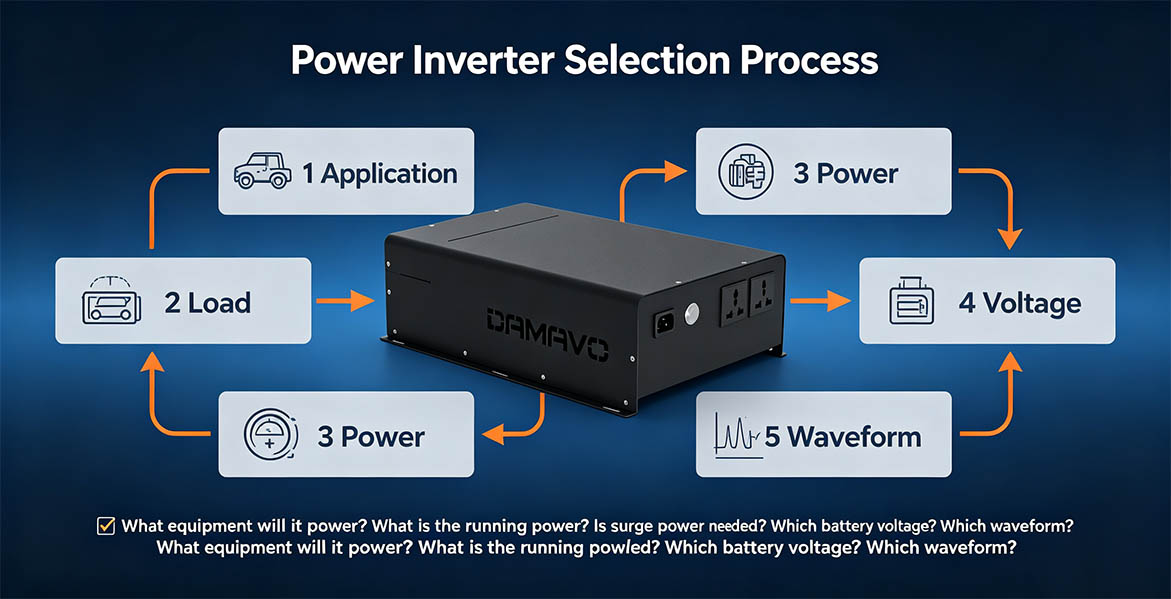
First, understand what you need to power. Then calculate the continuous and startup power. Next, match the inverter with your battery voltage and choose the waveform based on the load.
After these five points are clear, you can check other requirements such as protection functions, cooling, installation space, and operating conditions.
This approach can help you avoid a common mistake: choosing an inverter simply because its wattage looks high enough.
Power Inverter Selection Checklist
Before choosing the final model, ask yourself these five questions:
- What equipment will the inverter power?
- How much power does the equipment need during normal operation?
- Does the equipment have a higher startup power?
- Is the battery system 12V, 24V, or 48V?
- Does the load require Pure Sine Wave output?
If you can answer these five questions clearly, you have already completed the most important part of the power inverter selection process.
At DAMAVO®, we can then take the next step with you by looking at the actual load, input voltage, installation conditions, and application requirements. This helps turn a simple “I need a 3000W inverter” request into a more accurate and reliable power solution.
How to Choose a Vehicle USB Charging Port: 5 Key Factors to Consider
Power Inverters Manufacturer Guide: How to Choose the Right Supplier for Vehicles and Equipment
Related Article