Waterproof USB Port Buying Guide: How to Choose the Right Charging Port for Automotive and Marine Use
author: DAMAVO
2026-11-19
A USB port in your car may survive without an issue for years. Stick that same port on a boat, however, and it can be a different story.
Rain may find its way into places where you thought it never would. Saltwater can stain metal components. Moisture, even in minuscule amounts, in a charging port can lead to trouble in the long term.
This is why it’s a good idea to spend a little extra time on a waterproof usb port than simply selecting one based on the connector you need.
If you’re replacing an aging charger in your RV or purchasing USB ports for a new boat, here are a couple of things you should know before ordering.
Is Your USB Port Truly Waterproof?
Not every socket needs to be heavily protected from water.
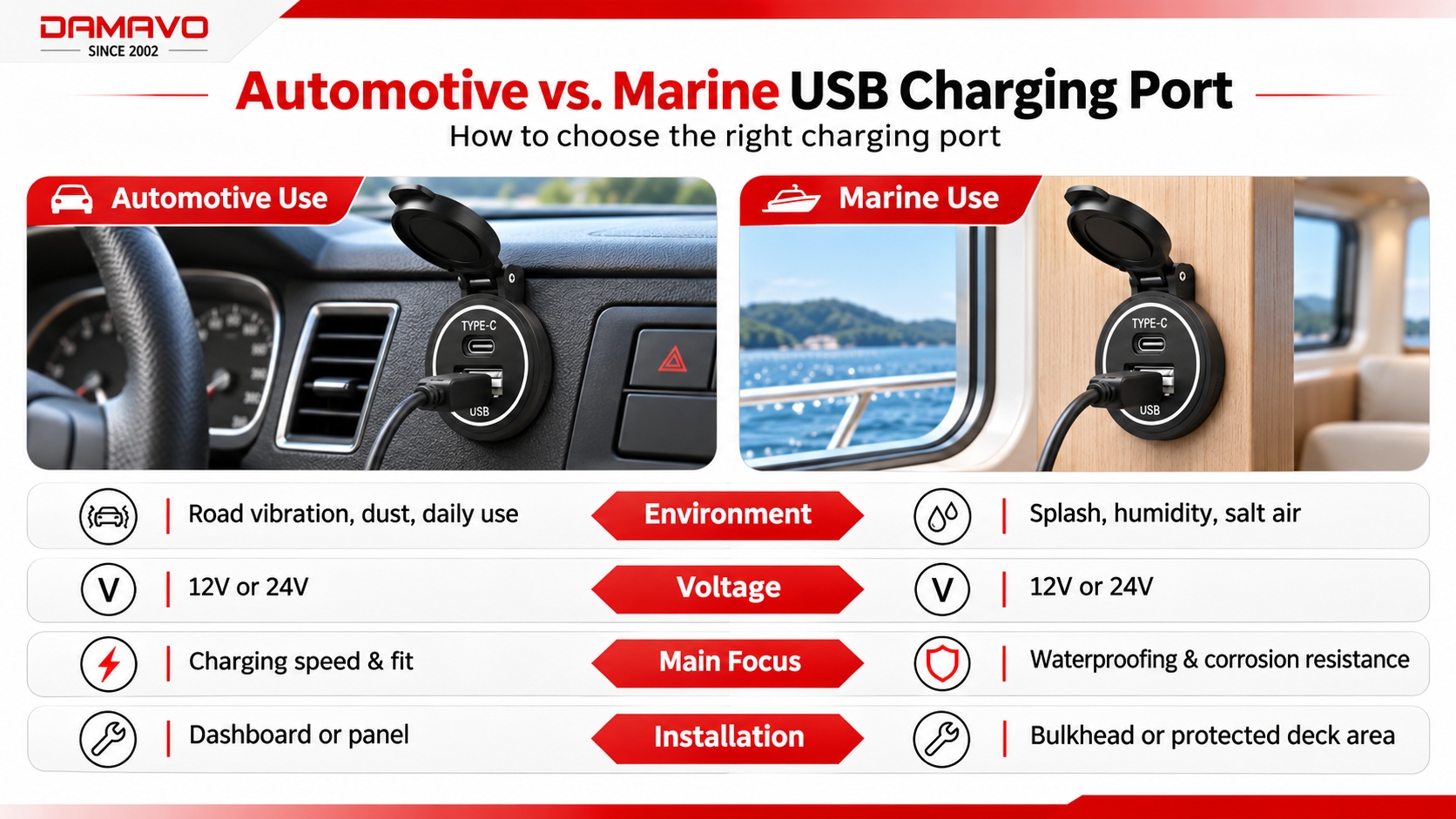
Imagine a USB charger located in a car. In the dashboard, as shown here. Actually, it is usually protected from rain, and water doesn’t often get down the connector. In this scenario, charging power, fit, and heat management could be more important.
Image you have a USB port next to the steering wheel of a fishing boat. The water splash it once the spray kick up. And then sometimes the boat is outside all day long.
That’s a different story.
Typically a waterproof USB port is closed in a cover, rubber seal or box, to prevent water from reaching the electrical parts.
However, some ports are only water resistant with the cap closed.
If you’re charging your phone with the socket exposed to rain or spray, don’t assume the waterproof number still holds. Check with the supplier to see how the port is protected when a cable’s plugged in.
It’s a little thing that makes a big difference.
Choosing an Automotive USB Charging Port
With Cars, Rv & Truck, the first thing to do is not take a look at the USB connector. It is to look at the energy supply.
Start With the Right Voltage
The majority of passenger cars are 12V electric systems. Larger trucks and buses are 24V.
A charging port designed for 12V only. It should not be hooked directly to 24v.
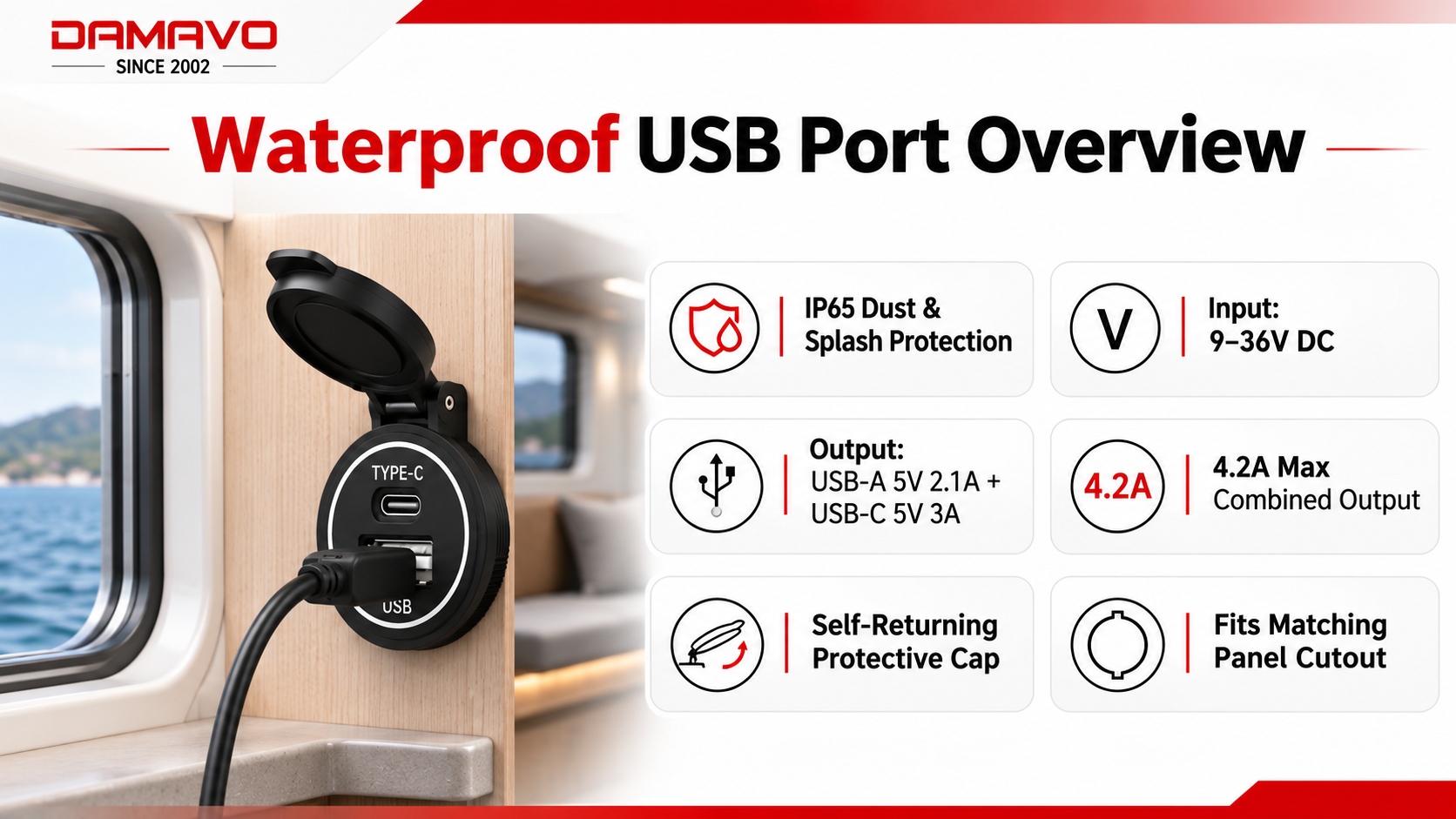
Many models of USB car charging port can use 12–24V DC power input, allowing them to be used in cars and trucks.
Nevertheless, look at the full spec. The voltage of the vehicle could fluctuate during normal use, so it is essential to know the supported operating range of the chargers.
Think About What People Will Charge
For a former phone, a GPS device, or a tiny device, an ordinary USB-A port is probably all you need.
USB-C is worth considering for customers with newer phones, tablets, or laptops.
If you are packing an EV/ … Both are helpful for your RV. Maybe one of you needs a USB-C for your tablet and the other is still using your regular USB-A cable.
And then there are the issues surrounding charging speeds (stay tuned!).
Don’t Forget the Mounting Space
Regardless of how good a charger looks online it does not mean that it will be difficult to install.
Panels, size of hole, and amount of space behind dash. Some head units have ports on the longer body of it which could interfere with wiring or other hardware located behind the dash.
If replacing a charger, make sure to record the mounting space before purchasing.
What to Look for in a Marine USB Charging Port
Boat owners have a few other concerns.
The water is the most obvious. Moisture is the obvious one. But you’ve also got to worry about salt, excessive sunlight, and exposed wiring.
IP Ratings: What Do They Really Mean?
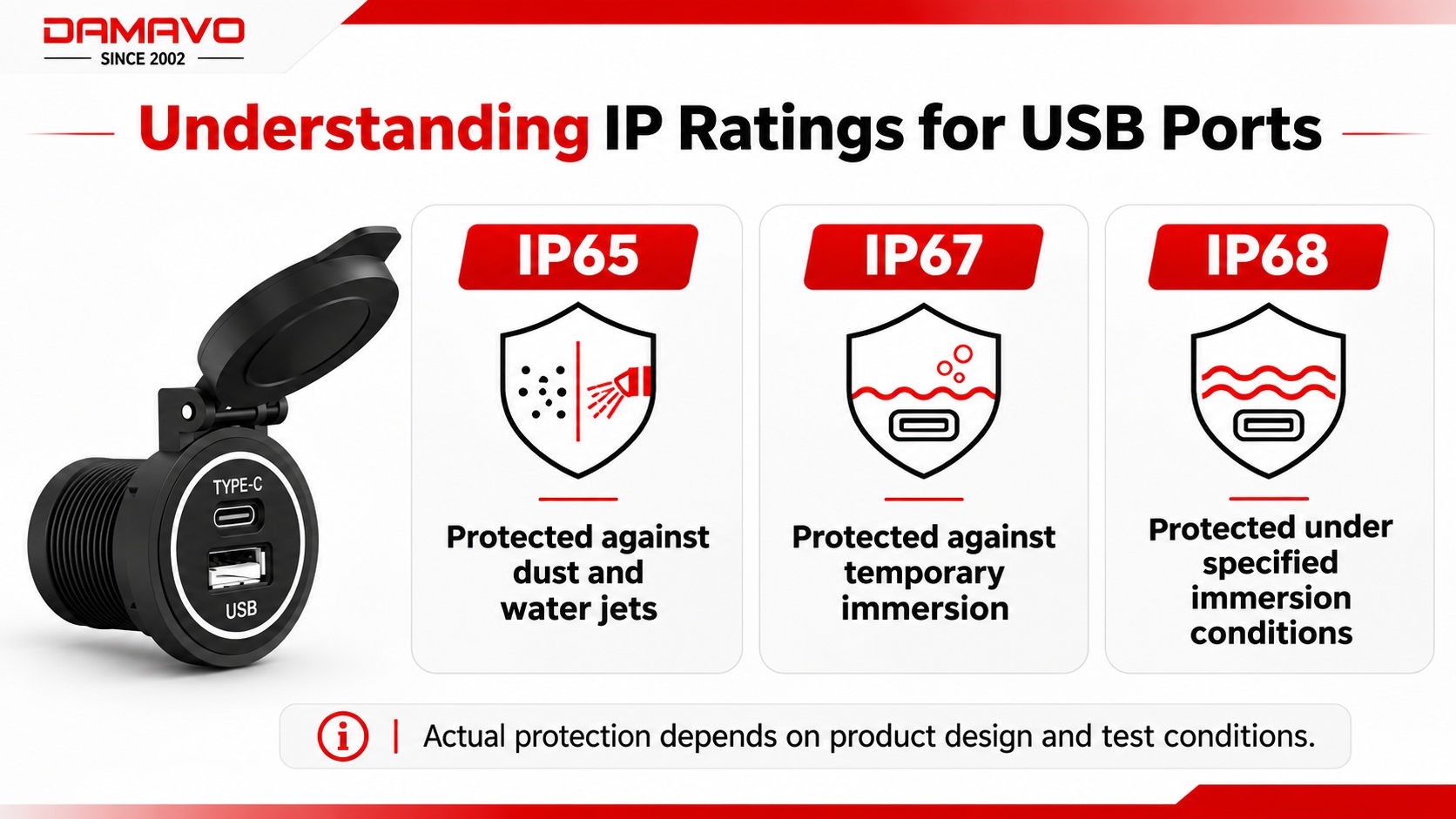
you’ve probably noticed the numbers IP65, IP67 or IP68 in the description of a product.
These figures specify the level of protection against ingress of dust and water, depending on the test conditions.
Here’s the basic difference:
RatingWater ProtectionIP65Protection from jets of waterIP67Protection from jets of water subjected to temporary immersionIP68Protection from jets of water subjected to prolonged immersion under specified conditions
While IP67 might be useful for devices that could be submerged for a short period, it doesn’t necessarily mean it is suitable for all water exposure.
For instance, IP67 testing doesn’t demonstrate a port can resist years of saltwater or withstand high-pressure cleaning.
When installing a marine USB charging port, consider the placement and water exposure.
A socket in a dry cabin may have completely different requirements than one located right beside an open deck.
Saltwater Is Another Problem
Waterproof and corrosion resistant are not the same.
With water blocked by a port but metal parts always around, corrosion can build up with each sea spray.
Search for appropriate housing materials, securely fitted seals, and protected electrical contacts.
If a saltwater environment is anticipated for the USB port installation, determine if the company has conducted salt spray testing.
Keep in mind the back of the socket Water may find a way to access the wiring from behind the mounting panel, even if the front is protected.
USB-A or USB-C: How Much Charging Power Is Enough?
There are a lot of tempting chargers that has the maximum wattage on the front.
But not always...
A 5V/3A USB output – up to 15W That might be enough to charge a lot of mobile phones and devices.
A 20W or 30W USB-C PD (Power Delivery) charger may be the right choice if you often use a tablet or a modern smartpho…
They are also available in more powerful configurations, such as 65W and 100W.
Just keep in mind though that a 100W charger won’t push 100W into every device. Real charging power is a combination of the device, cable, and charging protocol.
One more aspect to consider is whether the charger has dual-port output.
A 65W charging station might deliver the same power through one port, but divided when both ports are plugged in.
If multiple people plan to use the charger, verify the combined output rating before purchasing.
Is it Safe to Plug Automotive USB into a Boat?
Occasionally, sure.
For instance, a USB charger built for a car, which is installed within a weatherproof boat interior, might perform effectively if the device’s voltage, mounting style and environmental ratings fit the needs of your application.
However, an open deck...
On this, the port might be exposed to spray water, direct daylight and salty air. A design that has been tested for these conditions would be more preferable.
Instead of selecting merely by product name, carefully review the specifications.
Think about where the charger will go, how much moisture it will be exposed to and if it will be used outside by some users.
Those answers can often speak volumes more than a sign that says “automotive” or “marine”.
A Few Installation Mistakes Worth Avoiding
No matter how good your charger is, if it isn’t installed properly it could still get fried early on.
One mistake is to install the socket where water can build up in the socket. Another is not installing the sealing ring flat around the cavity or having a panel surface which does not permit the socket to be sealed.
Wiring does too.
Use cables that are rated for the current that will be drawn, and fit the correct fuse protection as per the manufacturer’s directions.
Before shutting the panel, try the charger on another device.
Make sure it powers on, remains firmly attached, and does not overheat while charging normally.
For boats, definitely check out the back connections. You may have a water proof front cover, but it’s no good if the back remains exposed to the terminals.
Buying USB Charging Ports for an OEM Project?
It is not too difficult to purchase one replacement charger but hundreds or thousands of them for a vehicle or marine equipment is going to require more thought.
You want the same sizes, consistent charging capabilities and a form factor that can make it into the actual final product.
Make sure you get the detailed drawings and electrical specifications before dealing with a supplier. For water-proof protection, check the testing conditions and request the testing report if it exists.
Also, find out if the provider can accommodate varied USB configurations, various mounting options, and differing power levels.
Our PRODUCTS Who We Are REpower & Relax Damavo ABOUT US We are a US-based company manufacturing USB chargers for the automotive, RV, marine, industrial, and power sport markets. We produce panel-mount USB-A & USB-C chargers, as well as high power PD chargers.
With OEM and ODM projects, we help clients make a review for electrical specifications, installation space, and designing requirements. Confirm waterproof performance and necessary testing for the model or custom design.
Frequently Asked Questions
Is an IP67 USB port completely waterproof?
Not a single product is waterproof in every situation. IP67 is a protection level for short periods of immersion and is achieved in a fixed test. It does not imply protection to salt water corrosion or with the USB cover open.
Can I install a waterproof USB port in my RV?
Is weatherproofing worth it? Yes. These ports are great for adding to your RV bathroom, kitchen, or even outdoor setup when you have moisture involved. Double-check that you’re selecting the correct voltage and dimensions for your RV.
Is USB-C better than USB-A for charging in a car?
USB-C might be better for more modern devices that you’re going to need fast charging for. It’s still useful for older devices, too, but you may get more use out of a dual port charger, which has both.
Can I use a 12V USB charger in a 24V truck?
Adjusting to 24V Input Only for charger with 24V input rated. Please check the rated input voltage before installation. Do not connect the charger with 12V rating directly to a 24V system.
Will a waterproof USB port work while it’s raining?
It also depends on the design of the product. Certain USB sticks may be water resistant only when closed. Without that confirmation of protection from the manufacturer, keep the USB connection away from the water when charging.
Final Thoughts
Not all waterproof USB port are made the same.
A charger parked inside a dashboard isn’t subjected to the same conditions as one exposed on an open deck. And a port dedicated to charging phones has different power requirements than one designed for laptops.
Begin with the place of installation. Proceed with the voltage, charging power, waterproofing protection, and mounting requirements.
Looking to buy USB charging ports for a vehicle or for a marine installation project? If yes, DAMAVO is ready to help you learn about the available charging products and OEM/ODM possibilities.
Dual USB C Car Charger Guide: Power Options, Vehicle Fitment, and OEM Integration
Related Article
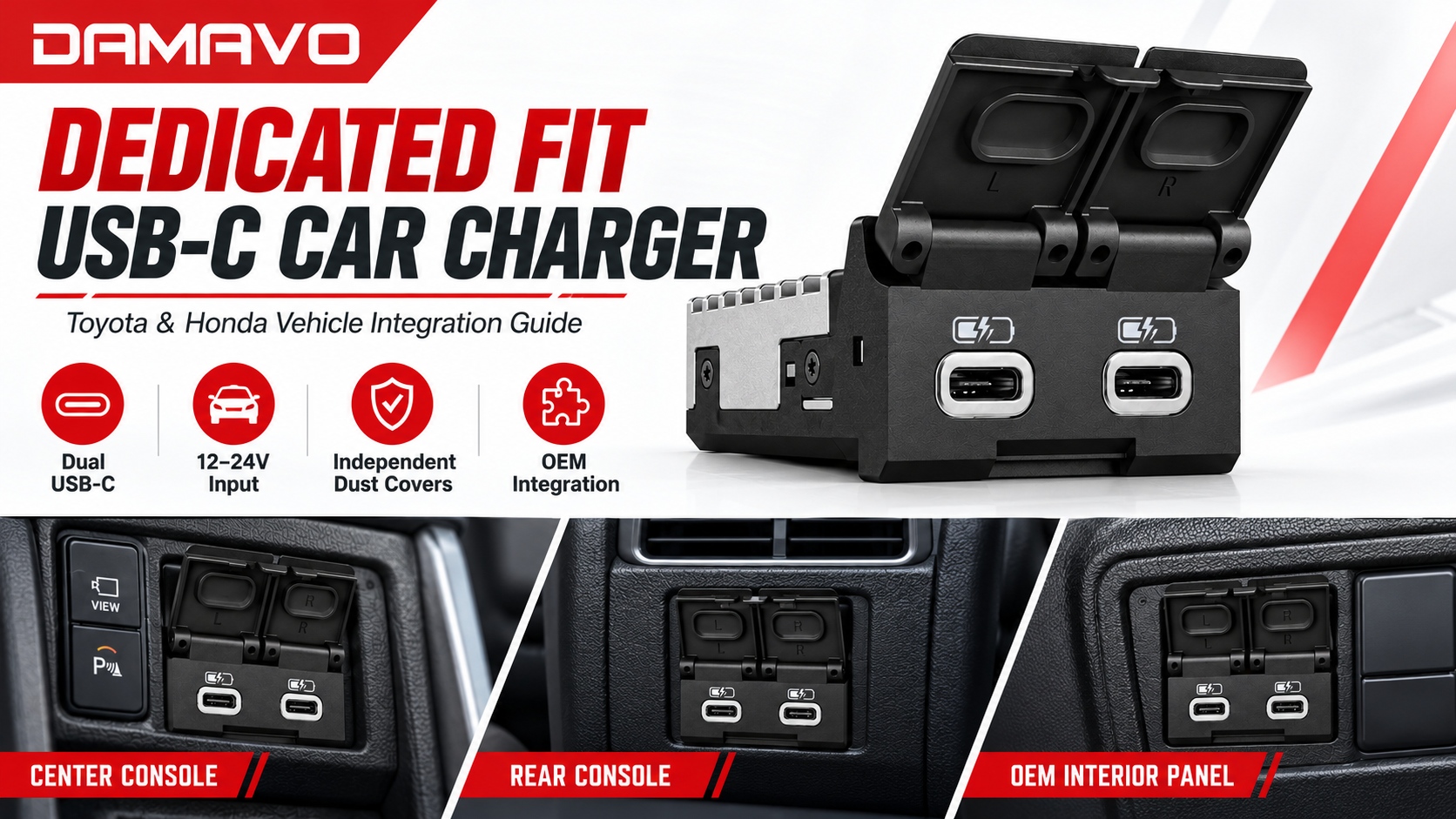
Learn how to choose a dual USB C car charger for Toyota and Honda applications. This guide covers charging power options, 12–24V input, vehicle fitment, electrical protection, LIN communication, and OEM integration for automotive charging projects.
Dual USB C Car Charger Guide: Power Options, Vehicle Fitment, and OEM Integration

Learn how turnkey PCB assembly connects PCB design and assembly, prototype PCB assembly, SMT production, functional testing, and PCBA manufacturing into one complete process for OEM projects.
PCB Assembly Guide For PCB Design and Assembly up to PCBA Manufacturing
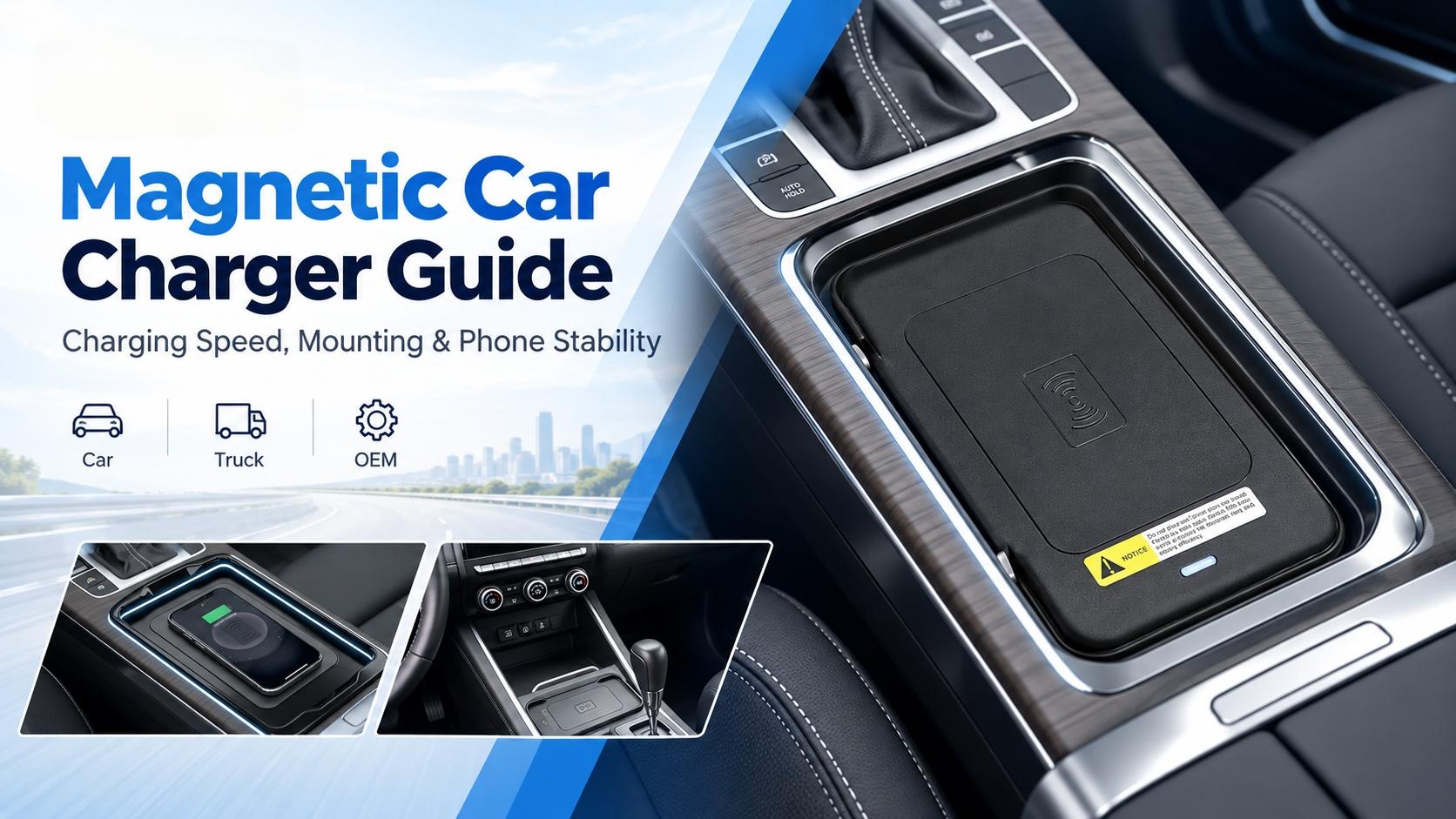
Learn how to choose a magnetic car charger by comparing charging speed, magnetic alignment, phone stability, heat, and mounting methods. This guide also covers magnetic wireless charger and car wireless charger options for cars, trucks, and OEM vehicle projects.
Magnetic Car Charger Guide: Charging Speed, Mounting & Phone Stability