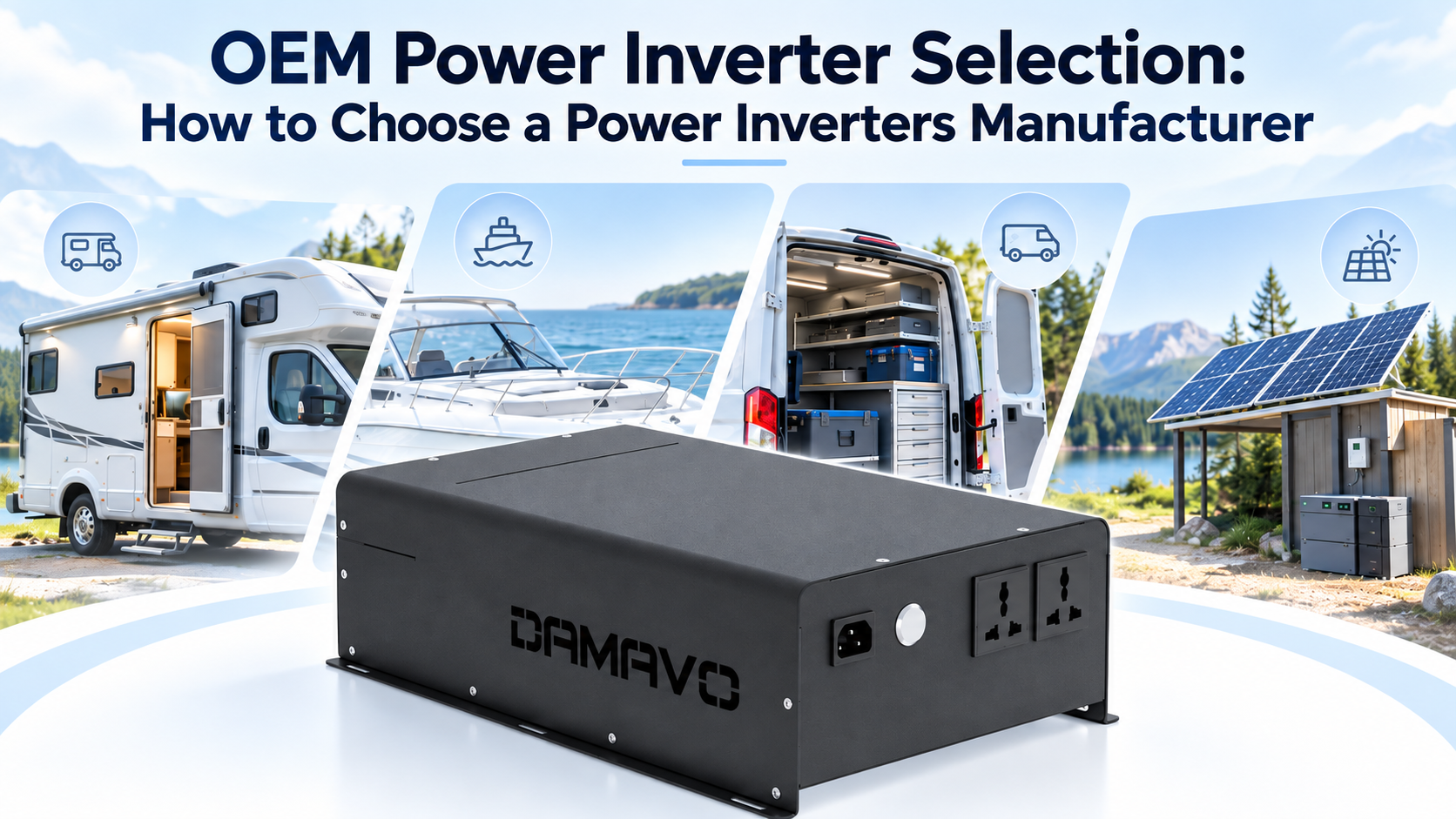
OEM Power Inverter Selection: How to Choose a Power Inverters Manufacturer
Power inverter selection may seem easy. Voltage, wattage, size, price. For an OEM project that is not sufficient. The inverter needs to be compatible with the battery system, the load, the wiring and the environment where it will be installed.
The requirements of an inverter for an RV are different from those used onboard a boat or equipment. The factory of the power inverters is also matter. A good power inverters manufacturer must be mastering the design, PCBA production, cooling, protection, testing and series production.
Main things to remember to check when choosing a product or supplier are:
What Is a Power Inverter?
A power inverter is used to covert DC power into AC power. A 12V, 24 V or 48 VDC battery may supply the electrical equipment at 110 V, 120 V, 220 V or 230 V AC.
The inverter makes that change possible.
The aspect of the unit concerned with its operation consist of the power circuit, the control board, the cooling system and the protection circuits.
Faulty cooling/insufficient protection resulting in excessive heat, output instability, or insufficient durability.
Even two power inverters rated for the same wattage could be very different.
Pure Sine Wave or Modified Sine Wave?
One of the first things to check is the output waveform.
Pure sine wave inverters deliver a clean, steady AC power similar to that of the utility. Typical applications include motors, refrigerators, telecom equipment, medical instruments and sensitive electronic equipment.
Modified sine wave models are usually cheaper, but they are not suitable for every device.
Some motors may run hotter. Some chargers or audio products may not work as expected.
For many vehicle, marine, industrial, and off-grid systems, pure sine wave power inverters are the safer choice.
You can also check THD, or total harmonic distortion. Lower THD usually means cleaner AC output.
Should You Use 12V, 24V, or 48V?
There is no single best voltage.
The right choice depends on the battery system and the total power level.
12V Power Inverters12V
inverters are common in cars, small RVs, and lighter power systems.
24V Power Inverters24V
models are often used in trucks, commercial vehicles, and larger RVs.
48V Power Inverters48V
models are more common in higher-power systems, energy storage, and some industrial or off-grid projects.
At the same output power, a higher DC voltage usually means lower current.
Lower current can help reduce heat and cable loss.
Still, the inverter voltage should match the full electrical system. A higher voltage is not always the better choice.
Do Not Choose Wattage by Guessing
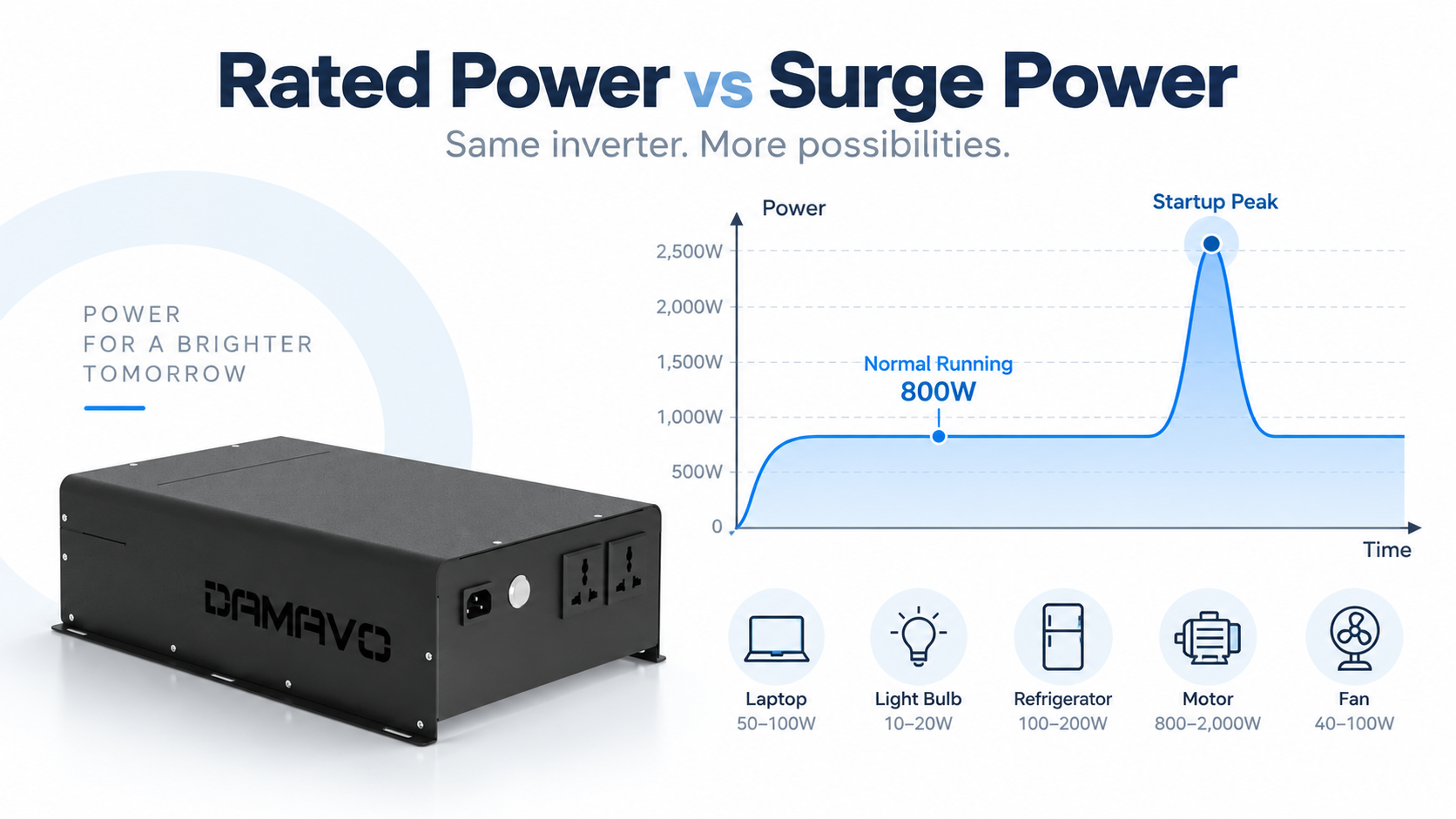
Rated power does not tell the whole story.
Some loads need much more power when they start than when they are running.
Motors, pumps, refrigerators, and compressors are common examples.
A device may use 800W during normal operation but need much more for a short time at startup. This is called surge power.
If the inverter cannot handle that short peak, it may shut down even when the normal running load looks safe.
Before choosing a model, check:
- Normal running power
- Startup power
- Load type
- Number of devices used at the same time
- Working time
A useful power inverters manufacturer should ask about these points before suggesting a model.
Protection Is Not an Extra Feature
Protection functions are easy to overlook, but they matter.
A power inverter works with batteries, high current, and electrical loads. When something goes wrong, the protection system needs to react.
Common functions include:
- Overvoltage protection
- Undervoltage protection
- Overload protection
- Overcurrent protection
- Overtemperature protection
- Short-circuit protection
- Reverse polarity protection
These protections are especially important in vehicles, where battery voltage and load conditions can change during use.
For some OEM projects, protection limits may also need to be adjusted to fit the final system.
What Should You Check in a Power Inverters Manufacturer?
A product page can show voltage and wattage, but it cannot tell you how the factory works.
For OEM projects, it is worth checking three areas.
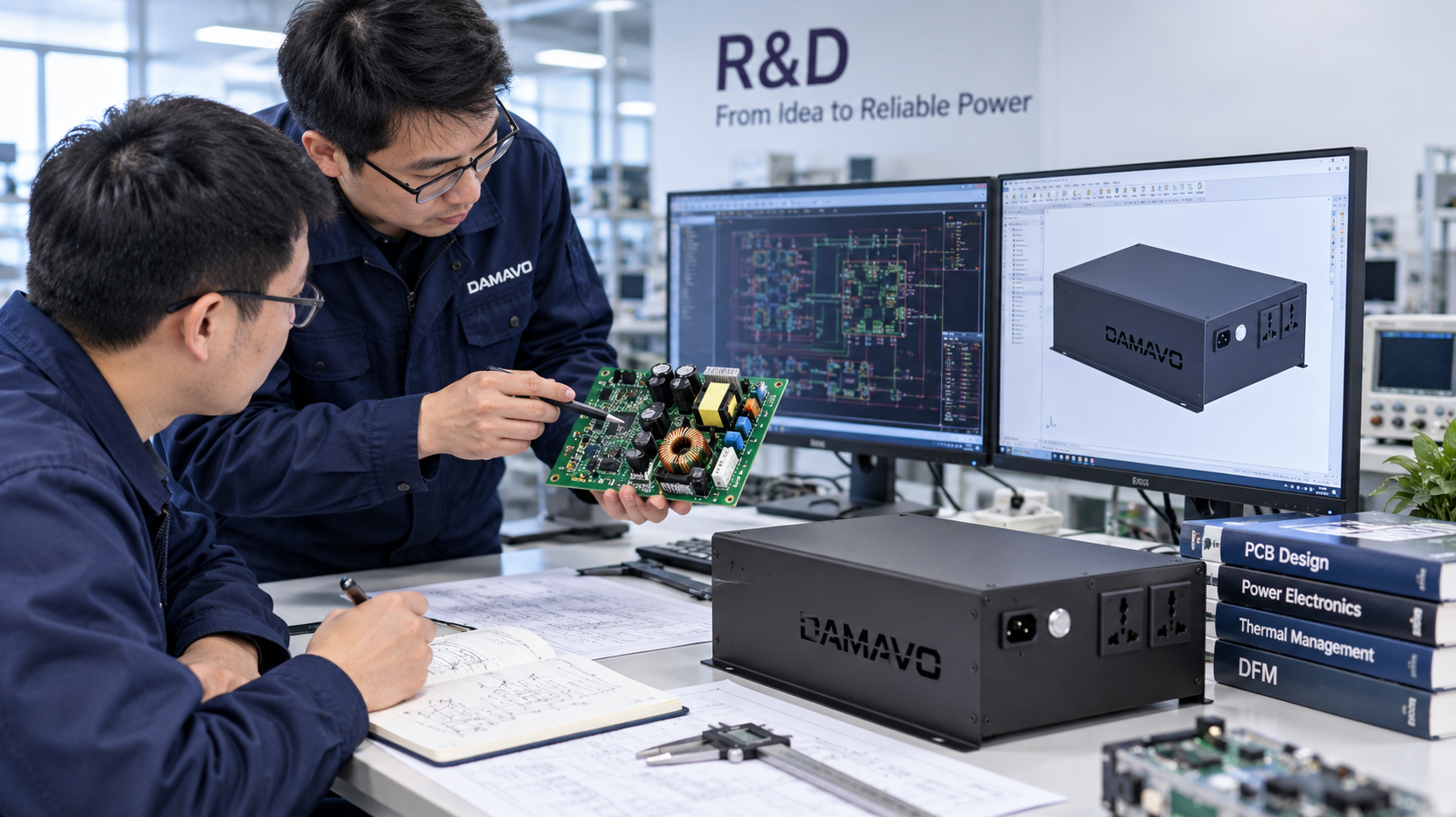
Engineering Support
Custom projects often change during development.
You may need another voltage range, a different connector, a smaller case, another cooling method, or different protection settings.
A factory with its own engineering team can usually handle these changes more directly.
Useful skills include PCB design, hardware design, firmware support, thermal design, mechanical design, and DFM review.
PCBA Production
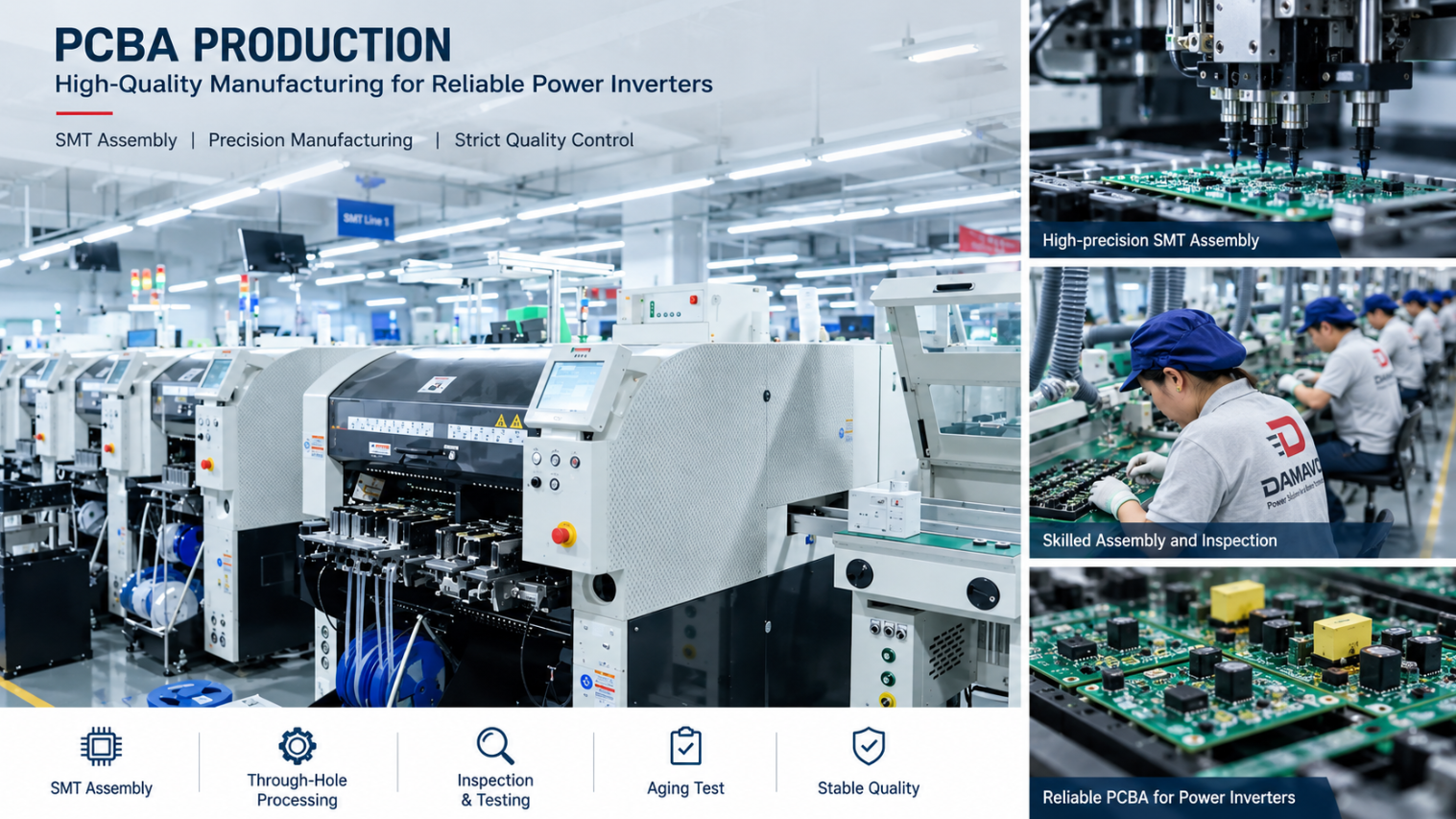
The PCBA is one of the main parts inside the inverter.
Its quality affects the whole product.
Ask whether the factory handles SMT assembly, through-hole parts, soldering, inspection, functional testing, and aging testing.
More control over PCBA production can also make design changes and quality checks easier.
Testing and Quality Control
Turning the inverter on is not enough.
A better test plan may include:
- Functional test
- Full-load test
- Aging test
- Temperature test
- Vibration test
- Humidity test
- Protection test
Not every project needs every test, but the supplier should be able to explain what is tested.
For automotive projects, ISO 9001 and IATF 16949 can also help buyers judge process control and quality management.
What Can an OEM Power Inverters Manufacturer Customize?
An OEM power inverters manufacturer can usually do more than change the logo.
Custom options may include:
- Input voltage
- Output voltage
- Frequency
- Rated power
- Surge power
- AC sockets
- USB or Type-C ports
- Anderson connectors
- Remote control ports
- Housing size
- Mounting points
- Labels and color
- Fan control
- Protection settings
- Communication functions
Some projects need deeper changes.
For ODM work, the supplier may also help with circuit design, PCB development, housing design, prototypes, testing, and pilot production.
This is useful when the inverter must fit a certain vehicle, machine, battery pack, or control system.
A Good Sample Is Only the First Step
Many buyers focus on the first sample.
The sample is important, but mass production is the bigger test.
Can the factory make 500 units that work like the sample? What about 5,000?
Before full production, a small pilot run can help check assembly steps, test fixtures, work instructions, and inspection points.
Problems found here are much easier to fix than problems found after a large shipment.
Stable production also depends on good process control.
Electronic SOPs, test fixtures, inspection records, traceability, controlled soldering, functional tests, and aging tests can all help reduce differences between batches.
For B2B buyers, this is often more important than how good the first sample looks.
Where Are Power Inverters Used?
Power inverters are used in many systems, including:
- Cars and commercial vehicles
- Trucks
- RVs and camper vans
- Boats
- Emergency vehicles
- Industrial equipment
- Battery energy storage
- Solar and off-grid systems
Each use case has different needs.
Vehicle ApplicationsA
vehicle inverter may need to handle vibration and voltage changes.
Marine ApplicationsA
boat may need better protection against moisture.
Industrial ApplicationsAn
industrial unit may need to run for long hours without overheating.
A supplier with experience in your type of application may be easier to work with because the team already understands these issues.
Choosing the Right OEM Power Inverters Manufacturer
There is no single question that can tell you if a supplier is right.
Look at the full picture.
Can the factory support engineering changes? Does it control PCBA production? How are products tested? Can it handle custom requests? Can it keep the same quality during a large production run?
DAMAVO has more than 20 years of experience in automotive and marine electrical products. The company supports OEM, ODM, and JDM power electronics projects.
The products and services it provides include support for PCB design, manufacturing of the assembled PCB, SMT assembly, functional testing, aging testing and validation of products. Production is conducted according to the standards of ISO 9001 and IATF 16949.
In a custom inverter project, the objective is not simply to produce a functional prototype. The real goal is to produce a product that will remain stable when the project goes into mass production.
Frequently Asked Questions
What Is a Power Inverter?
It converts DC power from a battery into AC power, which is used to run electrical devices.
24V or 12V?
Even if at same power, 24V can reduce the current, the right one needs the full battery and system design.
Why Select a Pure Sine Wave Inverter?
Pure sine wave outputs are a better match for many motors, chargers and delicate electronic equipment.
How Much Inverter Power Do I Need?
Check normal running power and startup surge power.
What Can an OEM Inverter Factory Customize?
Common changes include voltage, power, connectors, housing, mounting, protection settings, and control functions.
What Should I Ask a Power Inverters Manufacturer?
Ask about engineering support, PCBA production, testing, quality control, OEM options, and mass production control.
Magnetic Wireless Car charger: How does Fast charging influence a Magnetic Car charger
How to Choose a Vehicle USB Charging Port: 5 Key Factors to Consider
Related Article